
WELCOME BONUS 300%
UP TO €2000 + 100
FREE SPINS
UP TO €2000 + 100
FREE SPINS
Home → Blackjack
Blackjack at Dragon Casino: Variants, Rules and Payouts
A Side Bet Every Round: The Budget Lasts 30 Rounds
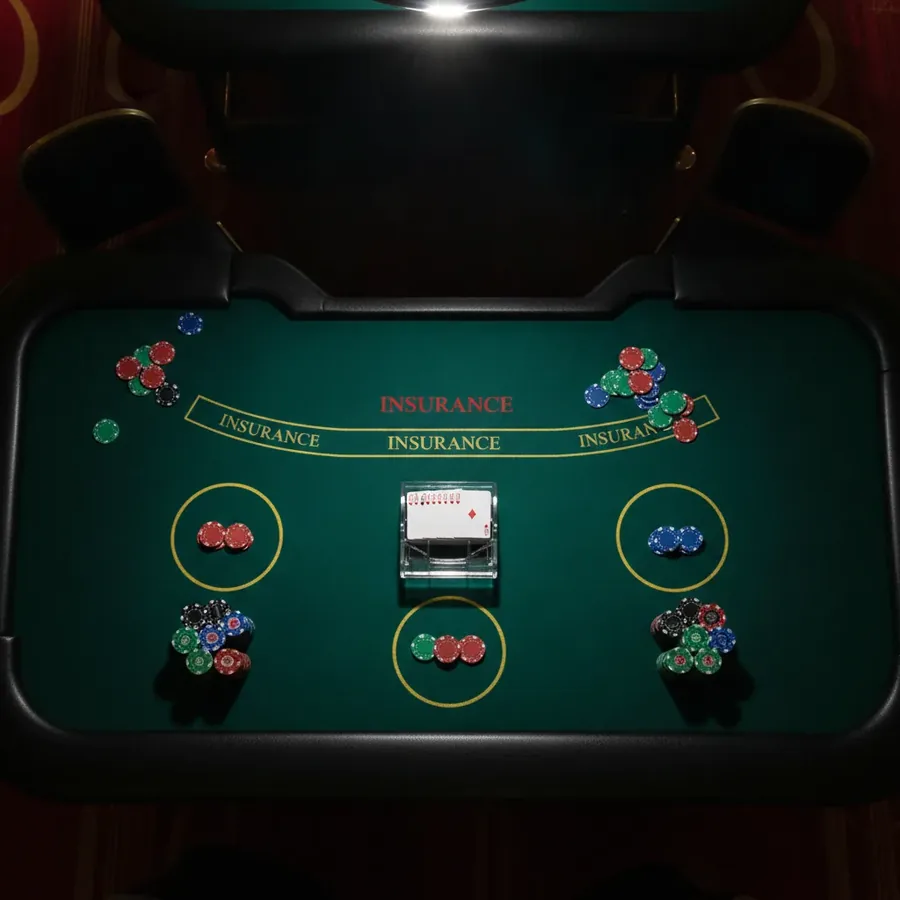
Insurance on a six-deck or eight-deck shoe returns 92.53% to the player, so the house edge on that separate wager is 7.47%. The bet may be placed for up to 50% of the main stake whenever the dealer shows an ace, and it settles at 2:1. It is a side bet, not part of the blackjack hand itself.
Over 100 rounds with a €10 insurance bet each time, the average cost is €10 x 100 x 7.47% = €74.70. A player who insures every single round therefore burns through a €500 bankroll in roughly 30 rounds at that rate. Basic strategy declines insurance in every case except for card counters at a true count of +3 or higher.
With a single deck the insurance edge falls to about 5.88%, which is still far above the 0.28% house edge of Blackjack Liberal Vegas Strip. The gap between 7.47% and 0.28% is the reason insurance is treated as a separate, expensive wager. On a €10 main bet the side bet is capped at €5.
Calling Late Surrender Correctly in Three Steps
Late surrender is a rule modifier that improves the return by about 0.08 percentage points, and it applies only after the dealer has checked for blackjack. The player gives up the hand and loses half the stake, so a €10 bet returns €5. Early surrender is worth up to −0.6 percentage points but is extremely rare.
Step one: check whether the table allows surrender at all, because Blackjack Liberal Vegas Strip includes it while the six-deck S17, DAS, DOA game with a 3:2 payout does not. Step two: wait until the dealer has checked the hole card for blackjack. Step three: announce surrender before acting on the hand, and accept the return of 50% of the stake.
The value is small but measurable: on 100 € staked across many hands, the rule saves about €0.08 in expected loss. Compared with the 0.46% house edge of the six-deck S17 game, surrender trims that figure to roughly 0.38%. It does not turn a losing hand into a winner; it only reduces the size of the loss.
Double Down or Just Hit on 11
Doubling after a split improves the return by about 0.14 percentage points, and doubling down on any first two cards is part of the six-deck S17, DAS, DOA game with a 3:2 payout and 99.54% RTP. A double puts the stake at 2x and the player receives exactly one more card.
On a €10 bet, doubling commits €20 in total, while a simple hit keeps the stake at €10. Over 100 identical situations, the extra €10 per double is wagered at the same 0.46% house edge, so the expected cost of the additional stake is €10 x 100 x 0.46% = €4.60. The double wins more often in expectation than a single hit on 11.
Basic strategy is required to reach the 99.54% figure, and it prescribes doubling on 11 against most dealer upcards. Resplitting aces improves the return by 0.08 percentage points, and a six-deck shoe beats an eight-deck shoe by about 0.02 percentage points. A hit on 11 remains the fallback when doubling is not allowed.
Stand-on-17 Rule and Its Meaning for Players
The dealer hitting soft 17 lowers the return by 0.22 percentage points, which is the largest single rule penalty after the 6:5 payout change. Blackjack Liberal Vegas Strip uses S17 and reaches 99.72% RTP with a 0.28% house edge, while the six-deck S17, DAS, DOA game sits at 99.54% RTP and 0.46%.
The difference between 0.28% and 0.46% is 0.18 percentage points, and on 100 € of stakes that is €0.28 against €0.46 in expected loss. Replacing a 3:2 payout with 6:5 adds 1.39 percentage points to the casino's edge, far more than the H17 penalty. On a €10 bet a blackjack pays €15 at 3:2 and only €12 at 6:5.
A player comparing tables should treat S17 as a baseline and check the payout before the dealer rule. Blackjack Single deck with classic rules and a 3:2 payout reaches 99.85% RTP and a 0.15% house edge, the lowest figure among the variants, but a 6:5 payout on one deck can erase that advantage.
Blackjack variants at a glance
| Variant | Payout | House edge | Rule | RTP |
|---|---|---|---|---|
| Blackjack 6:5 payout instead of 3:2 (6 decks) | Blackjack 6:5, win 1:1 | 1.85% | Replacing 3:2 with 6:5 adds exactly +1.39 percentage points to the casino's edge – more than any other rule change. On a €10 bet a blackjack pays €12 instead of €15. | 98.15% |
| Blackjack Split / double / H17 – rule effects | Double – stake ×2 with one card; split – up to 4 hands; split aces usually get one card each. | H17 +0.22 percentage points; RSA −0.08 percentage points; DAS −0.14 percentage points | Dealer hitting soft 17 lowers RTP by 0.22 percentage points; resplitting aces improves it by 0.08 percentage points; doubling after a split improves it by about 0.14 percentage points; 6 decks instead of 8 – about 0.02 percentage points. | n/a (rule modifiers) |
| Blackjack Insurance (6–8 decks) | Insurance 2:1 | 7.47% | Separate side bet of up to 50% of the main bet when the dealer shows an ace. Basic strategy ALWAYS declines it (except for card counters at a true count ≥ +3). With a single deck the edge is ≈ 5.88% | 92.53% |
| Blackjack 6 decks, S17, DAS, DOA, 3:2 payout, basic strategy | Blackjack 3:2, regular win 1:1, insurance 2:1 | 0.46% | Dealer stands on soft 17; double down on any first two cards; doubling after a split allowed; no surrender. Basic strategy is required to reach this figure | 99.54% |
| Blackjack Surrender (late surrender) – rule effect | 50% of the stake returned | −0.08 percentage points | The player gives up the hand after the dealer has checked for blackjack and loses half the stake. Improves RTP by about 0.08 percentage points. Early surrender is worth much more (up to −0.6 percentage points) but is extremely rare. | n/a (rule modifier) |
| Blackjack Single deck, classic rules, 3:2 | Blackjack 3:2, win 1:1 | 0.15% | Fewer decks = lower edge; one deck gives about −0.48 percentage points compared with 8 decks. Often offset by a 6:5 payout. | 99.85% |
No Doubling Down on Three Cards
Doubling down is a blackjack option that allows a player to double the original stake and receive exactly one additional card, and it is normally available only on the first two cards of a hand. A three-card hand cannot be doubled in the standard game, because the option has already expired once the player takes a third card; the moment the third card arrives, the stake stays at its original level.
Rule data show what the restriction costs or saves. Allowing doubling after a split is worth about 0.14 percentage points of house edge, while doubling on any first two cards appears in a six-deck set with a 99.54% RTP and a 0.46% house edge. The three-card ban is therefore a structural limit on when the stake can grow, not a separate charge.
For a player, the practical effect is that a 10 EUR bet stays at 10 EUR once a third card is drawn; only the first two cards permit a second 10 EUR. Insurance is a separate side bet of up to 50% of the main bet and pays 2:1, but basic strategy always declines it. A hand of three or more cards can still win at 1:1.
Place Side Bets Before the Cards Are Dealt
The side bets available at Dragon Casino's live blackjack tables must be committed before the dealer begins dealing any cards to the players. At Infinite Blackjack from Evolution, the four side bets are Any Pair, 21+3, Hot 3, and Bust It, all of which require a separate stake placed in the designated betting area. Once the first card leaves the shoe, no side bet can be added or removed for that round.
The timing matters because side bets in blackjack carry their own probabilities and house edges that differ sharply from the main game. Insurance is a classic example: the separate side bet of up to 50% of the main bet is only offered when the dealer shows an ace, and it must be taken before the dealer checks the hole card. Insurance pays 2:1 but has a house edge of 7.47% on a six- to eight-deck shoe, and basic strategy always declines it for a non-counter.
At Infinite Blackjack, the main game RTP of 99.47% is reduced for any player who regularly adds side bets with lower returns. A 1 euro side bet on Any Pair or 21+3 is completely separate from the 1 euro main bet, so the total stake per round is 2 euro. The side bet can win only if the specific card combination appears after the deal, but the main hand continues independently with its own 3:2 blackjack payout.
Clicked Too Late? The Hand Stands Automatically
When a player at an Evolution live blackjack table does not click a decision button before the timer reaches zero, the software automatically holds the current hand value. At Infinite Blackjack, this means no additional card is drawn and no split or double is placed, because the hand is treated as if the player chose to stand. The bet remains in play against the dealer's final total.
The automatic hold has a direct effect on expected return when the player would otherwise have taken a basic strategy action. A missed double on two cards forfeits the chance to stake twice the original amount with one card to come, and a missed split on a pair loses the option to create up to four hands. With the six-deck S17 game returning 99.54% under correct play, a held hand that should have been doubled or split lowers the realized return for that round below the theoretical figure.
The RTP of 99.56% for Lightning Blackjack assumes that every decision is made in time and follows basic strategy. A held hand that loses costs the full stake, while a held hand that wins still pays 1:1 unless the blackjack itself was the result.
What the Hole Card Means at a Live Table
A hole card in a live blackjack game is the dealer's second card, which is dealt face down and remains hidden until all player hands are completed. The dealer's first card is face up, and the hole card is checked only when the upcard is an ace or a ten-value card, because this is when a dealer blackjack is possible. If the upcard is any other value, the hole card is not checked until the dealer's turn.
The hole card rule directly affects the insurance decision at Dragon Casino's tables. If the dealer shows an ace, players may place an insurance side bet of up to 50% of the main bet before the dealer checks the hole card for a ten-value card. Insurance pays 2:1 when the hole card completes a blackjack, but the house edge on this bet is 7.47% for six to eight decks, and basic strategy always declines it except for card counters at a true count of at least +3.
The S17 rule in the six-deck game means the dealer stands on soft 17 after revealing the hole card, which contributes to the 99.54% RTP. If the dealer's hole card plus the upcard totals 17 with an ace counted as 11, the dealer does not draw, whereas H17 would add 0.22 percentage points to the house edge. At a live table, the moment the hole card is revealed determines the final dealer total and whether each player hand wins, pushes, or loses.
Stop the Session After a 30 Percent Loss
A session stop at 30 percent loss means ending play for the day when the current bankroll has fallen to 70 percent of its starting amount. For a player who deposits 100 euro, the stop triggers when 30 euro has been lost and only 70 euro remains. The rule is a boundary on the stake, not a change to the game's RTP or house edge, which still runs at 0.46% for the six-deck blackjack game with 3:2 payouts.
Applying the stop to the 300% welcome bonus up to 2,000 euro shows the scale: a 100 euro deposit creates 300 euro of bonus money for a 400 euro balance, and a 30 percent loss on that total is 120 euro. In blackjack terms, the average loss on 100 euro of stakes at the 99.54% RTP table is 0.46 euro, so a 120 euro stop loss corresponds to roughly 26,087 euro of total action at that edge, though variance makes individual sessions unpredictable.
The stop-loss figure can also be expressed in blackjack outcomes. A 10 euro bet that loses is a full 10 euro step toward the 30 percent stop, while a blackjack win at 3:2 pays 15 euro and moves the bankroll upward by that amount. The six-deck game with S17, DAS, and DOA does not guarantee any win or loss streak, but the 30 percent line prevents a player from continuing after the bankroll has dropped by that fixed share.
One Deck vs Eight Decks: The House Edge Gap
Blackjack Single deck, classic rules, 3:2 carries an RTP of 99.85% and a house edge of 0.15%, which is the average share of each stake the casino keeps over the long run. The same rules played with eight decks instead give a house edge of 0.46%, so the extra seven decks cost the player 0.31 percentage points. On €100 of stakes that difference is €0.31 per hundred wagered, and the one-deck figure is the lowest house edge named for any blackjack variant here.
The comparison is narrower than it looks, because one deck gives about −0.48 percentage points compared with eight decks, and that advantage is often offset by a 6:5 payout. Blackjack 6:5 payout instead of 3:2 on six decks runs at an RTP of 98.15% with a house edge of 1.85%. Replacing 3:2 with 6:5 adds exactly +1.39 percentage points to the casino's edge, more than any other rule change.
The step-by-step reading for a beginner is to check the payout before the deck count. A 3:2 blackjack pays €15 on a €10 bet, while a 6:5 blackjack pays only €12, so €3 is lost per blackjack even on a single-deck table. A single-deck game that pays 6:5 can therefore return less than a multi-deck game that pays 3:2.
Continuous Shuffling Machines Reshuffle After Every Round
A continuous shuffling machine returns the cards to the shoe after each round, so the composition of the remaining deck is effectively reset for every hand. The rule effects sit at H17 +0.22 percentage points, doubling after a split at −0.14 percentage points and 6 decks instead of 8 at about 0.02 percentage points. Those three figures describe how a rule set moves the house edge, and a machine that reshuffles every round removes the deck-depth factor from that list.
Continuous shuffling interacts with card counting rather than with the payout table. Insurance (6–8 decks) has a house edge of 7.47% and an RTP of 92.53%, and basic strategy always declines it except for card counters at a true count of +3 or higher. Because a continuous shuffling machine leaves no depleted shoe to count, that one exception never becomes available, so the 7.47% edge on the side bet applies to every insurance decision.
The step-by-step consequence is that a player using basic strategy is unaffected in the figures but loses the option of a count-based decision. Blackjack 6 decks, S17, DAS, DOA, 3:2 payout with basic strategy reaches an RTP of 99.54% and a house edge of 0.46%, and that 0.46% is achieved without any counting. On €100 of stakes, €0.46 is the expected cost per hundred wagered.
Early Surrender Is Gone From Many Tables
Late surrender is the rule that remains: the player gives up the hand after the dealer has checked for blackjack and loses half the stake, and the rule improves RTP by about 0.08 percentage points. Early surrender is worth much more, up to −0.6 percentage points, but it is extremely rare. The gap between the two is roughly 0.52 percentage points of house edge.
In money terms, late surrender returns 50% of the stake, so €50 comes back on a €100 bet, while early surrender would avoid the hand before the dealer checks for blackjack. Blackjack Liberal Vegas Strip (liberal rules, 3:2) includes late surrender alongside S17, DAS and resplit, and reaches an RTP of 99.72% with a house edge of 0.28%. Standard deviation on that rule set is 1.15.
The step-by-step check for a beginner is to look for the word surrender in the rule list and then confirm which type it is. A table without surrender still runs at 99.54% RTP when it uses six decks, S17, DAS, DOA and a 3:2 payout, so the missing 0.08 percentage points is small next to the 1.39 percentage points lost by a 6:5 payout.
Blackjack Party Has Two Hosts
Blackjack Party from Evolution is a live blackjack table with a party atmosphere and two hosts, and its bet range runs from €1.00 to €1,000.
The step-by-step comparison starts with the stake range. A player staking €10 per hand at Blackjack Party is at the bottom of a €1.00 - €1,000 range, so the table accommodates small stakes, while Lightning Blackjack starts at €1 and reaches €2,500. The 99.56% RTP of Lightning Blackjack is higher than the 99.47% of Infinite Blackjack, a gap of 0.09 percentage points, which on €100 of stakes is €0.09.
The two hosts are a presentation feature of Blackjack Party and do not change the payout table, so the rules of the underlying game still set the return. A 3:2 blackjack still pays €15 on a €10 stake and a 6:5 blackjack still pays €12, regardless of which live table is chosen, and the 300% welcome bonus up to €2,000 plus 100 free spins can be used at any of these tables subject to the casino's terms.
Contact
Live - online chat
Banking









Providers












Dragon Casino 2026